
From “I don’t know where to start” to a next step.
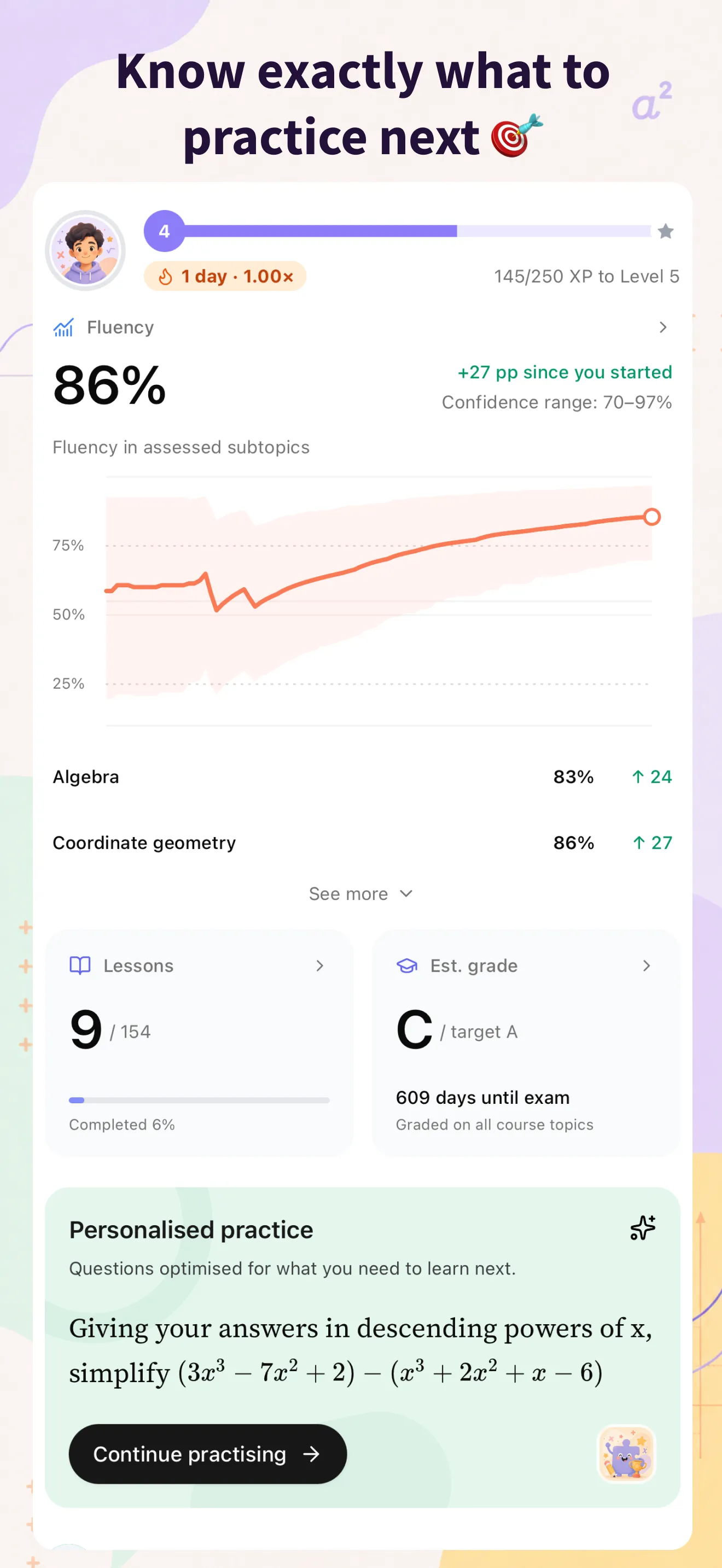
Lessons, a structured learning roadmap and practice informed by what they’ve worked on. Earlier gaps can become a place to begin.
For parents · Their next chapter
They’ve pictured the course, the university, the next chapter. When that future depends on a maths grade, getting stuck can feel much bigger than a difficult homework question.
Shared with you · A-Level Maths
Across the current catalogue, including foundation, A-level and further content. Browse the learning roadmap to find the right starting point.
A little support can mean a lot
Behind the target grade is a young person picturing their future. A place at university. A course they love. The relief of opening a question and knowing where to begin.
You don’t need to become their maths teacher. Give them somewhere to turn when they’re stuck, a next step when revision feels overwhelming, and a way to see the effort they’re putting in.
Lessons, a structured learning roadmap and practice informed by what they’ve worked on. Earlier gaps can become a place to begin.
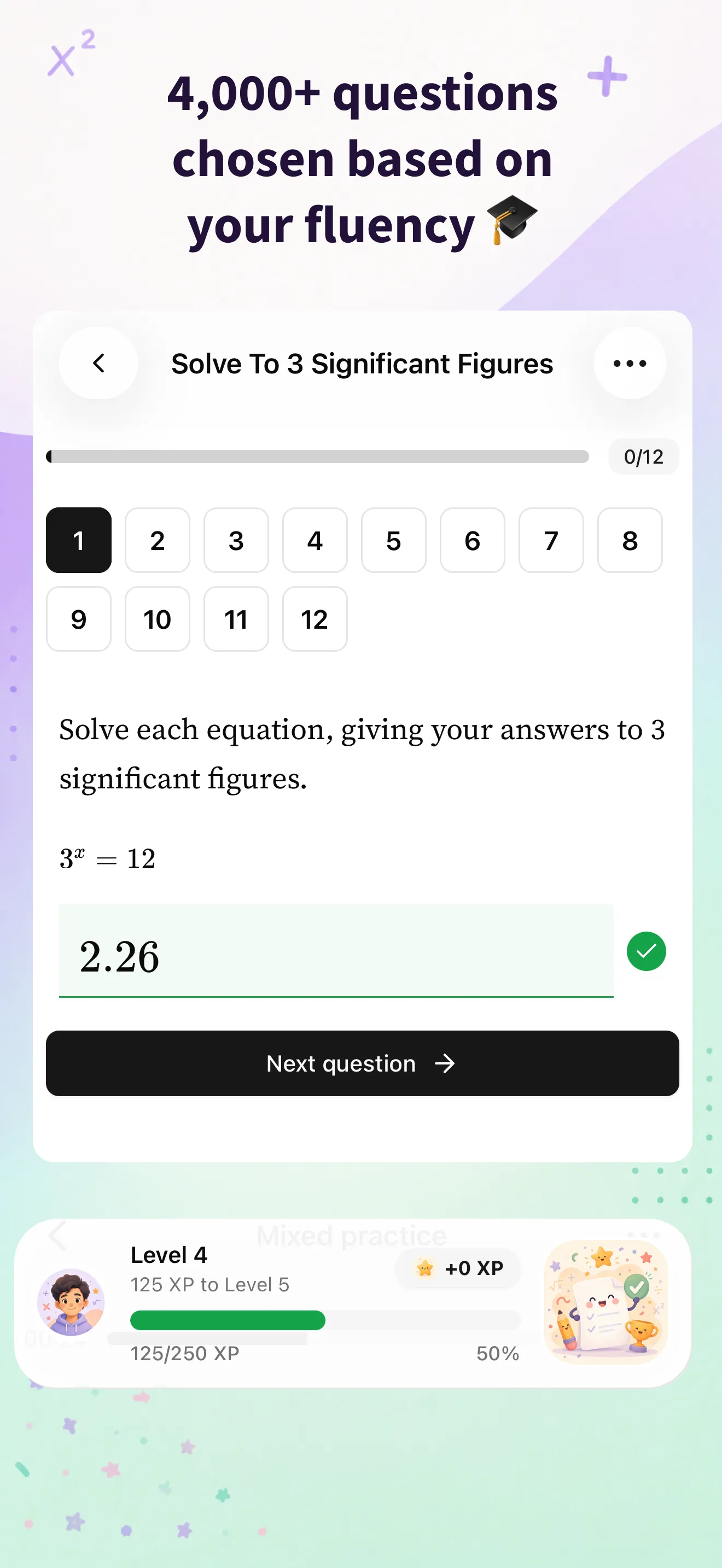
Supported answer checks, hints and worked solutions help them understand the method and return to trying it themselves.
Questions, worksheets and progress give you something concrete to talk about. They choose the snapshot they share with you.
One foundation. Bigger ambitions.
Maybe they light up talking about medicine. Maybe it’s engineering, chemistry or building something with code. Behind so many of those ambitions are mathematical skills they’ll use again and again.
When an equation stops being a stumbling block, they have more room to focus on the science behind it. Helping them strengthen their maths can support the mathematical parts of their other STEM subjects too.
of AQA’s A-level Physics assessment involves mathematical skills at Level 2 or above.
Rearranging an equation. Reading a graph. Using trigonometry to resolve a force. Maths helps them turn a physical idea into an answer.
See AQA’s Physics assessment →of AQA’s A-level Chemistry assessment involves mathematical skills at Level 2 or above.
Ratios in mole calculations. Rearranging concentration formulae. Logarithms in pH. The same foundations keep turning up in a different lesson.
See AQA’s Chemistry assessment →Logical reasoning, functions and algorithms feature in AQA’s A-level Computer Science content.
Breaking a problem into steps. Understanding how a function grows. Checking whether a solution makes sense. Mathematical thinking belongs here too.
Explore AQA’s computing content →Support the maths behind their ambitions. Give them more opportunities to practise the skills they can carry into their next lesson, their next exam and the future they’re picturing.
Back their next step →The percentages describe AQA assessment content, not expected grade improvements. Progress across subjects depends on applying those skills alongside subject-specific study.
50% introductory launch offer
A good tutor can make a difference in an hour. What your child does on the evenings in between matters too.
At the £9.99 monthly launch price, give them a place to keep practising, check supported answers and see their progress. At home, between lessons, whenever they’re ready to work.
£30 is an illustrative hourly rate; tutor prices vary. Tutorful’s pricing guide gives a general range of £20–£45 per hour. MathLab is independent practice support to use alongside teaching or tutoring.
See how to cover their Pro →£19.99 is the planned future standard monthly price. Monthly billing renews until cancelled. Three months is a comparison at the launch price, not a fixed-term package. Checkout confirms offer availability, duration and renewal terms.
If your child sent you this page, they’re asking for support with something that matters to them. They may have a university offer to meet, a course they hope to apply for, or a mock result that has knocked their confidence. Sharing a resource is a way of saying: I want to do something about this.
Take that seriously. It can be hard to admit that effort isn’t producing the results you hoped for, especially when friends seem to know where they’re going next.
You know the person behind that grade. The one who talks about a course with their eyes lit up. The one who says revision is fine, then sits with the same question open for twenty minutes. You may not know which mathematical step they are missing. You can still help them take the next one.
A difficult question shouldn’t make their future feel further away.
Missing a required maths grade can mean reconsidering a course, a university or when to start. For some students, it means another year preparing and reapplying. That isn’t inevitable: universities may still accept students who miss an offer, and Clearing can provide other options. UCAS explains the results-day routes.
But the worry is real. Getting useful support now gives your child something practical to do with it.
They’ve already taken a step by asking for support. Help them keep going.
See how to cover their Pro →An evening set aside for maths can disappear into searching for a worksheet, getting stuck on the first question, then watching an explanation without trying again. A student can genuinely spend time studying and still be unsure what they have learnt.
MathLab brings lessons and practice into a structured sequence. Your child can choose a topic, work through an explanation, attempt questions and check supported answers while the problem is still fresh. Hints and worked solutions help them examine the method, then return to doing the work themselves.
Imagine they understand an algebra example in class but cannot start the homework alone. Their next session can have a specific purpose: revisit that idea, try the relevant questions and identify the step that keeps going wrong. That gives them something useful to take back to their teacher.
The learning roadmap helps you see how the material fits together. The catalogue includes foundation work as well as A-level and further content, so a missing earlier skill can become a clear starting point.
MathLab records progress through questions, worksheets and milestones. That makes it easier for your child to show what they have been working on and where they will go next.
Use that history to start a conversation. “Show me one question that makes more sense now” is more useful than repeatedly asking whether revision is finished.
| What to look at together | What it tells you |
|---|---|
| Completed questions and worksheets | Which material they have practised |
| A mistake they can explain | Whether they understand something that previously went wrong |
| A fresh question attempted without help | Whether they can apply the method independently |
| Teacher feedback and timed exam work | How that learning is carrying over into assessed work |
A streak can encourage them to return. A completed worksheet can feel satisfying. The goal is being able to solve the next problem with less help.
Agree on a brief weekly check-in that your child helps shape. Let them choose what to show you, including the parts they still find difficult. The calm revision plan offers a useful starting routine.
That is the conversation you want: a mistake they now understand, a topic they are willing to try again, a little more confidence about the next session. Covering Pro gives them more room to practise and a fuller record of the work they are doing.
Average additional progress associated with feedback approaches in the EEF’s wider education evidence. Read the feedback research.
Average additional progress associated with metacognition and self-regulation approaches: learning to plan, monitor and evaluate study. Read the learning-strategies research.
These are averages from studies of educational approaches, not MathLab results or a promise of extra months for your child. They cannot be added together. Applying the approaches well matters.
The practical lesson is straightforward: students need opportunities to understand mistakes and make informed decisions about what to practise next. MathLab provides a place to attempt work, check supported answers and review solutions. Encourage your child to explain what they will change on their next attempt.
Give their next study session a clearer starting point.
Support their next step →MathLab’s founder received a U in maths, then a D on a second attempt. Friends left for university while he continued into another year at college. After substantial further study and tutoring, he achieved an A in maths, two marks short of an A*.
That story contains an important moment. When the D felt like proof that all the effort had failed, his maths teacher recognised how much ground he had covered. Someone could see progress he could not yet see himself.
MathLab grew out of that experience: repeated practice, gaps addressed, explanations revisited and help sought when needed. The founder’s result predates MathLab; it explains the motivation for building it. Read the full story.
Your child’s route will be their own. They deserve support that helps them work towards it without making every difficult question feel like a verdict on their future.
Begin with the free resources. Ask your child to choose a topic from their current course, read the lesson and try the practice. Agree on a couple of study sessions, then ask what became clearer and where they still need help. This is a practical first-week suggestion, not a required study schedule.
If MathLab becomes a useful part of their routine, Pro provides more answer submissions and progress tracking across the full course.
| Option | Price | A useful starting point |
|---|---|---|
| Free | £0 | Browse the catalogue, read lessons and try a starter allowance of answer submissions |
| Pro monthly | Planned standard price £19.99/month; introductory launch price £9.99/month | 50% introductory launch offer, with more answer submissions and fuller progress tracking |
| Pro annual | Planned standard price £159.99/year; introductory launch price £79.99/year, billed upfront | 50% introductory launch offer; the annual launch price is approximately £6.67 per month for comparison |
Compared with 12 monthly payments at the £9.99 launch price, annual billing costs £39.89 less, a saving of approximately 33%. The annual amount is paid upfront. In-app subscriptions renew automatically through Apple; check the App Store for the current local price and billing terms before purchasing. Compare the plans.
Our planned standard prices are £19.99 per month and £159.99 per year. To help more families get started, the 50% introductory launch offers are £9.99 per month or £79.99 per year. This is an introductory price compared with what we intend to charge in the future. Checkout confirms offer availability, duration and renewal terms.
Three payments at the monthly launch price total £29.97. At that launch price, that is three months of MathLab Pro for less than a single tutor hour priced at £30. Four weekly lessons at that rate would cost £120. These are cost comparisons: a tutor provides human teaching, while MathLab supports the independent practice your child does alongside it. Tutor rates vary; see Tutorful’s pricing guide.
For a guardian purchase, where available, use the parent link your child sent you. Pay through Stripe on your own device; their Pro belongs to their existing account and your billing stays with you. Manage renewal through guardian billing. Three months is a comparison of monthly costs, not a fixed-term package; the subscription renews until cancelled; checkout confirms when any introductory price ends and the renewal price. Checkout confirms the current price and terms.
You don’t need to remember how to integrate a function to make a difference. Start by asking which topic they want help making time for this week.
You can back the effort they’re making, and the future they’re working towards.
Cover their MathLab Pro →No. You can help your child make time to practise, ask what they are working on and encourage them to take difficult questions to their teacher. They can use MathLab’s lessons and worked solutions for the mathematical explanations.
Yes. The free tier lets students browse paths, topics, worksheets and questions, read MathLab Learn and try a starter allowance of answer submissions. Pro adds more answer submissions and progress tracking across the full course. Check the pricing page and checkout for current terms. In-app purchases are confirmed by Apple; guardian purchases, where available, use Stripe.
Ask your child to show you what they have practised and explain a question they can now tackle. Review progress together on their device, and use teacher feedback and independently completed exam work to assess readiness. Completed worksheets alone do not establish a predicted grade.
No. MathLab provides structured learning and practice, but a result depends on the student’s starting point, work, teaching and exam performance. Use it alongside school or college study, and discuss concerns about their target grade with their teacher early.
At the £9.99 monthly launch price (50% below our planned £19.99 standard price), three payments at that price total £29.97, just below one tutor hour priced at £30. Tutor rates vary, and this is a price comparison between different kinds of support. The monthly subscription renews until cancelled; it is not a fixed three-month package. Checkout confirms the current price and terms.
Yes, where guardian checkout is available. Your child sends a parent link showing the progress they choose to share. You pay from your own device through Stripe, and Pro activates on their existing MathLab account. You do not need their password or the app. Billing emails go to the address you enter at checkout.
Use the guardian billing page and verify the email you used at checkout. You can manage payment details, view invoices and cancel renewal in Stripe’s billing portal. An in-app subscription is managed through Apple instead. The annual plan is paid upfront; checkout explains renewal and cancellation terms.
Research checked October 2026. Research estimates describe educational approaches, not measured outcomes from using MathLab.
Their next chapter starts with a next step
Ask which topic is holding them back. Open it together, look through the lesson and questions, and agree when they’ll practise this week. If they’ve asked for Pro, covering it is a simple way to say you believe in the work they’re putting in. Help them keep going towards the future they’ve pictured.